


.png)
One of the most common questions manufacturers face when moving to Shopify is which tier of tooling actually matches their requirements. Shopify's native B2B features are gated behind Shopify Plus. Third-party wholesale apps work on lower-tier Shopify plans. And some apps run on top of Shopify Plus to extend what the native B2B tooling doesn't cover.
Understanding where each option fits, and when the upgrade or addition is justified, is the practical question this post answers.
Before comparing features, it helps to be clear on what the three configurations actually are:
1. Shopify (Basic, Grow, or Advanced) + Wholesale App
Shopify's native B2B features (company accounts, catalogs, payment terms, quantity rules) are only available on Shopify Plus. On lower-tier Shopify plans, there is no native wholesale functionality. If you need tiered pricing, account-based catalogs, or payment terms on a standard Shopify plan, you need a third-party app to provide all of it.
2. Shopify Plus with Native B2B Only
Shopify Plus includes the full native B2B feature set: company accounts with location and role management, catalog-based pricing, volume pricing, quantity rules, net terms at checkout, PO number capture, ACH payments (US), and draft orders. No additional apps required for core wholesale functionality.
3. Shopify Plus + Supplemental B2B App
Some manufacturers on Shopify Plus add a supplemental app to extend the native B2B tooling in specific areas: buyer-facing quote workflows, advanced approval routing, quick order pads, or rep-on-behalf-of ordering.
Third-party wholesale apps can replicate most of what Shopify Plus B2B does natively, at a fraction of the platform cost. The trade-off is that the functionality is assembled from an external app rather than built into the platform, which introduces dependencies on the app vendor's update cycle and compatibility with Shopify's own changes.
Scenarios where this configuration is a reasonable choice:
Apps commonly used for this:
SparkLayer SparkLayer runs alongside any Shopify storefront and adds a full B2B ordering layer: customer-specific pricing, account registration with approval, quick order forms, saved product lists, rep ordering, and a buyer account portal. It works on non-Plus Shopify plans and integrates with Shopify Flow natively. Strong choice for manufacturers who want a polished B2B buying experience without the Plus price point.
BSS B2B Wholesale Solution A comprehensive app covering tiered pricing, custom registration and approval workflows, tax control, order limits, and company account management. Works across all Shopify plan tiers. Good option for merchants with multiple wholesale tiers and buyer approval requirements.
Wholesale Gorilla Simpler feature set: wholesale pricing, order minimums, and wholesale-specific discounts. Suitable for straightforward wholesale setups where a full account portal is not required.
Limitations to know:
On Shopify Plus, the B2B feature set is part of the platform itself. Key capabilities:
Company and account management:
Pricing and catalog:
Checkout and payments:
Orders and operations:
Automation:
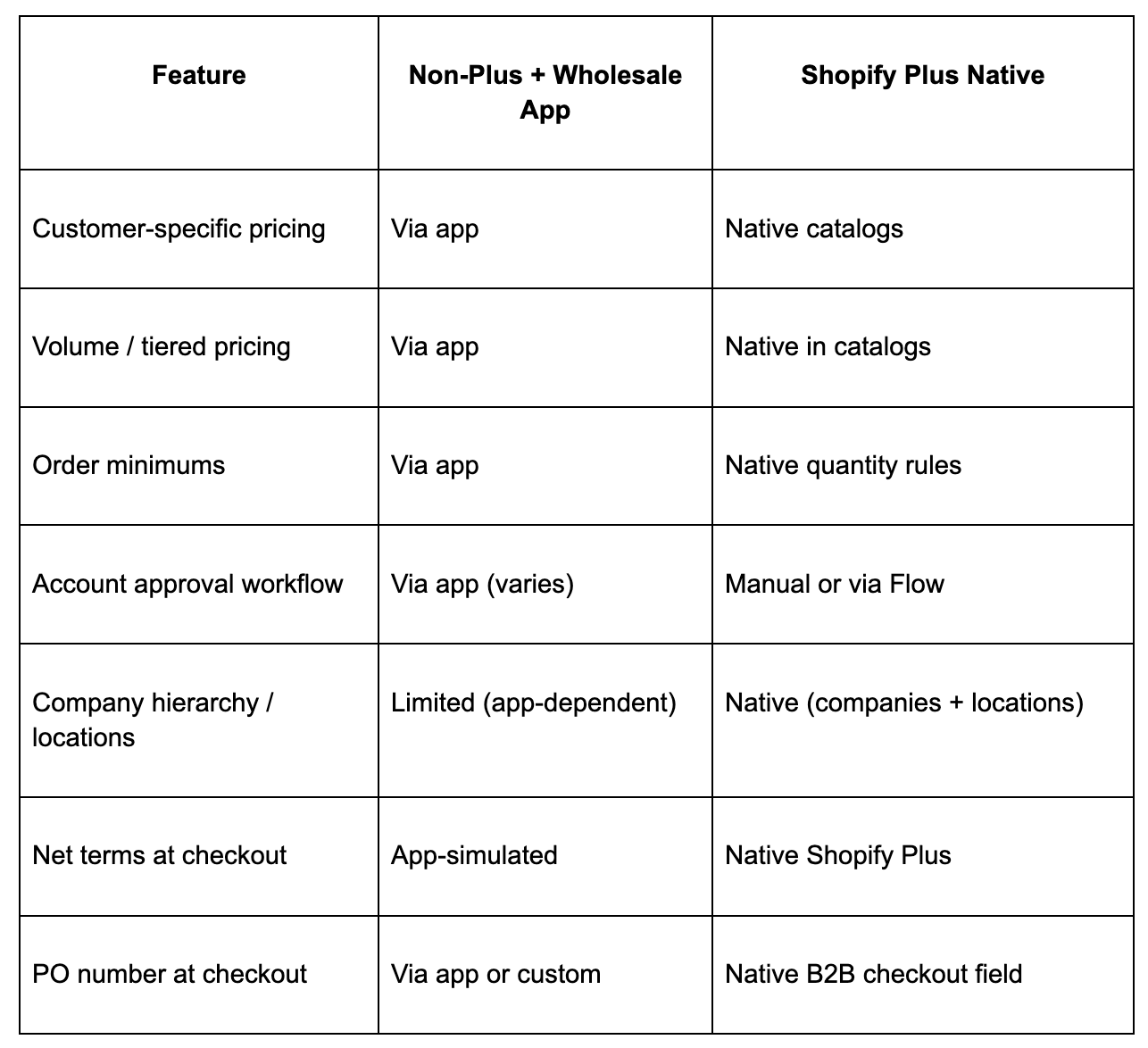

Some requirements aren't covered by native Shopify Plus B2B, and the solution is an app on top of Plus rather than a different plan:
Buyer-facing quote and RFQ submission: Draft orders are the native quote mechanism, but they require a sales rep to initiate. If buyers need to submit RFQs themselves (browsing products, building a list, requesting a price), apps like BSS Request a Quote or SA Request a Quote add that flow.
Advanced order approval routing: Shopify's order review rules flag orders for admin review but don't support multi-step routing. Duos B2B Management and custom development are the options for procurement-style approval chains.
Spending limits per buyer: Not available natively. BSS B2B Solution covers this.
Quick order / bulk order pad: Shopify's Horizon theme includes a native quick order list section. For merchants on other themes, SparkLayer or a standalone quick order app adds this without a full theme change.
Rep-on-behalf-of ordering: Sales reps placing orders on behalf of customers (logged in as the customer's account) is not a native feature. SparkLayer includes this.
Start with Shopify Plus native B2B if:
Consider non-Plus + wholesale app if:
Add a supplemental app to Shopify Plus if:

.png)
